Breaking News
Breaking News
from Washington and beyond

Lauren Boebert Has Another Weird Sex Scandal in the Family

More details are emerging about Tyler Boebert’s arrest for a crime spree.

Lauren Boebert stands in a hallway, partially obscured by shadow
Anna Moneymaker/Getty Images

The story around Tyler Boebert’s arrest just keeps getting worse.

Representative Lauren Boebert’s 18-year-old son allegedly made a sex tape with a minor, according to an affidavit following his arrest on Tuesday.

The younger Boebert was arrested over “a recent string of vehicle trespass and property thefts” in Rifle, a town in Colorado’s 3rd congressional district, which his mom currently represents, said police. He is facing 22 charges, including criminal possession of a financial device and criminal possession of ID documents.

But if that wasn’t bad enough, an arrest affidavit released by the Garfield County Clerk of Court noted Tyler “supposedly made a sex tape with” one of the other suspects, a female minor. That tape was reportedly sent around to people they knew. It’s not clear from the affidavit how old Boebert or the suspect were at the time they did so.

The four suspects involved are reportedly two female minors, one male minor, and the 18-year-old Boebert.

The affidavit also sheds more light on how exactly the four friends were caught. The investigation reportedly began on February 20, when a woman informed police that someone broke into her parked car and took her wallet the day before. The wallet contained a stolen card that was then used at various locations on February 19 and 20.

Police say that Tyler and his friends were out to steal people’s wallets and credit cards in order to use them for purchases. One of the victims included a woman with a brain tumor who said she had just $75 “left to her name,” according to police.

And how were they caught? Surveillance footage from one of the stores the cohort stopped at reveals Tyler wearing a gray “Shooters Grill” hoodie—the name of his mother’s former restaurant in Rifle, Colorado.

Lauren Boebert, for her part, said in a statement that her son “will take responsibility for his actions and should be held accountable for poor decisions just like any other citizen.”

“I love my son Tyler, who has been through some very difficult, public challenges for a young man, and the subject of attention that he didn’t ask for,” she said. “It breaks my heart to see my child struggling and, in this situation, especially when he has been provided multiple opportunities to get his life on track. I will never give up on him and I will continue to be there for him.”

Still, it’s a rough spot to be in for the Colorado representative who likes to rail about the “Biden crime family” every chance she gets. She’s already facing a tough congressional bid this primary season. Beobert chose late last year to move to and run in Colorado’s 4th congressional district, a much more right-leaning seat and thus one that should theoretically be an easier election win for her. That decision followed a rather embarrassing national spectacle when she and a date were caught on security cameras groping each other, vaping, and eventually getting kicked out of a performance of Beetlejuice.

Unfortunately, things still aren’t looking good for Boebert. During a campaign event earlier this month, Republicans weren’t impressed.

“I don’t appreciate, as a Christian, people saying they’re Christian to get your vote and then turning out to be a lowlife, and now I just kind of think of her as a lowlife,” one voter told The Wall Street Journal.
Missouri GOP Candidate: It’s OK, I’m Only an “Honorary” KKK Member

Darrell McClanahan III thinks his ties to the hate group aren’t that bad because he wasn’t an official member.

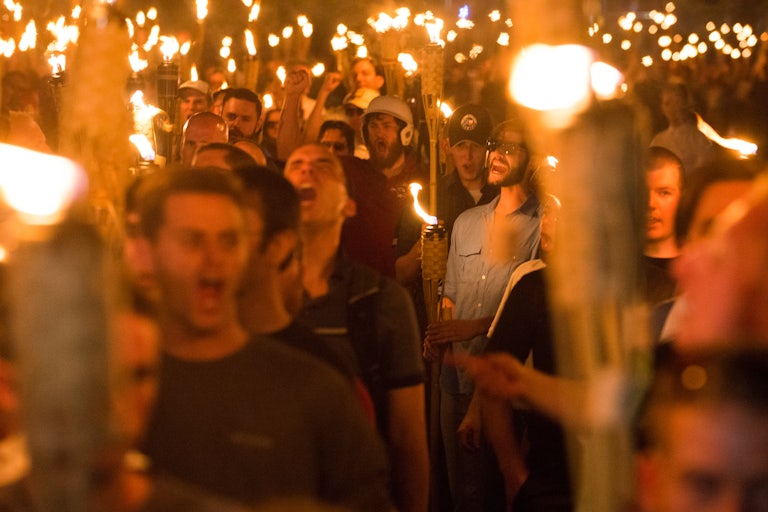
Young white men hold tiki torches and shout
Zach D Roberts/NurPhoto/Getty Images
Darrell Leon McClanahan III attended the 2017 Unite the Right Rally in Charlottesville, Virginia

It wasn’t all too long ago that political candidates would be disowned by their parties upon the discovery of ties to hate groups. But the first candidate listed on the unofficial Republican gubernatorial ballot in Missouri has been outed as a white supremacist—and nothing seems to be happening.

Darrell Leon McClanahan III’s name appeared even higher than the party’s front-runners due to the names being drawn in ballot order, with the lowest ballot numbers—such as McClanahan’s—appearing first. This is now the second time that the state Republican Party has accepted a filing fee and candidacy paperwork from McClanahan. The known white supremacist had a failed run for U.S. Senate in 2022, when he placed fifteenth in a group of 21 candidates, pulling more than 1,100 votes.

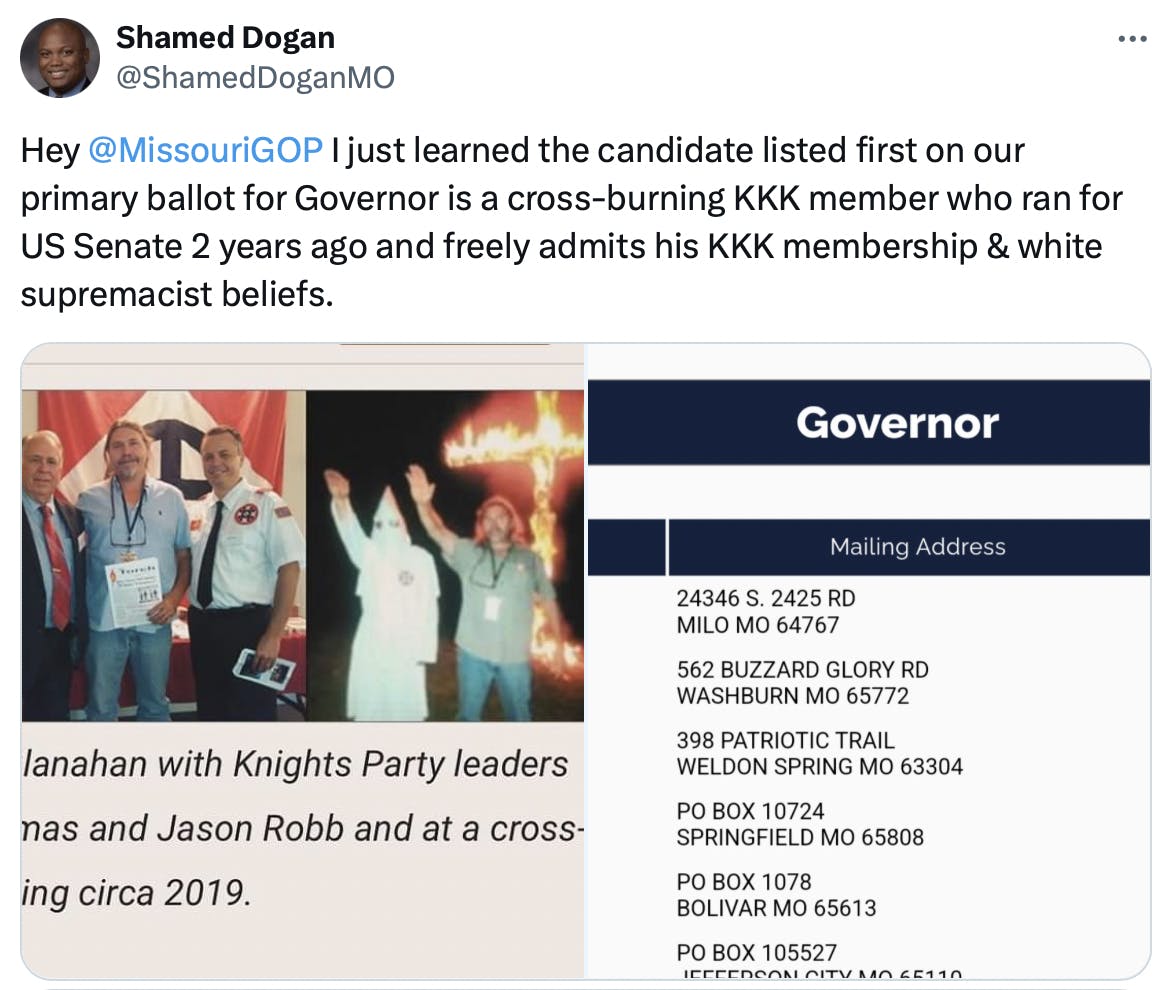
“Hey @MissouriGOP I just learned the candidate listed first on our primary ballot for Governor is a cross-burning KKK member who ran for US Senate 2 years ago and freely admits his KKK membership & white supremacist beliefs,” former Missouri State Representative Shamed Dogan wrote on social media, calling on the party to reject the “racist loser” as a candidate.

A tweet from Shamed Dogan

McClanahan has tried to downplay the facts, saying he is just an “honorary” member instead of a formal member of the Knight’s Party Ku Klux Klan. He identifies with the racist religious sect Christian Identity, and has attended several events hosted by the Arkansas-based Christian Identity Klan, including a cross burning in which he is pictured performing a Nazi salute beside a man clad in the KKK’s white-hooded garb. McClanahan tried to brush that off by describing the event as “religious Christian Identity Cross lighting ceremony.”

He has, however, advertised his membership in the League of the South, a white extremist group demanding a “white-dominated South,” according to the Anti Defamation League.

McClanahan also attended the 2017 Charlottesville “Unite the Right” protest—an experience that he wrote positively about for the Knights Party’s newsletter, The Torch, cataloging his descent into far-right, race-based radicalization.

In a defamation suit he filed against the ADL for aligning him with white supremacists and antisemites, McClanahan described himself as a “Pro-White man, horseman, politician, political prisoner-activist who is dedicated to traditional Christian values,” reported the RiverFrontTimes. The lawsuit has since been dismissed.

“Shamed Dogan I would like to respectfully request that you cease and desist from making defamatory statements about me on the X platform. Your statement about me being a cross-burning KKK member and white supremacist is false and damaging to my reputation,” McClanahan said in a statement to the RiverFrontTimes addressed directly to Dogan.

It is currently unclear if the Missouri Republican Party can or will reject McClanahan’s candidacy, or if he’ll make the official ballot come August.

The Three Johns Who Could Succeed McConnell, Ranked From Horrible to Worse

So far, the main contenders to replace Mitch McConnell are all men named John. What differentiates them?

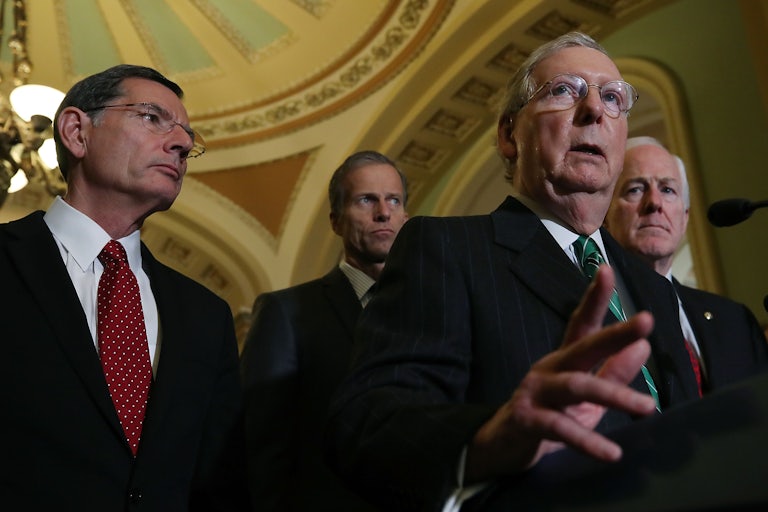
From left, John Barrasso, John Thune, and John Cornyn stand behind Mitch McConnell
Mark Wilson/Getty Images
From left, John Barrasso, John Thune, Mitch McConnell, and John Cornyn

Republicans have until the end of the year to replace Senate Minority Leader Mitch McConnell, who announced Wednesday he will step down as the longest-serving Senate leader in American history. But that hasn’t stopped GOP lawmakers from clamoring about who would take his place.

So far, the candidate pool is (perhaps unsurprisingly) looking a little monotonous, with the top three contenders all old, white men named John. They include Minority Whip John Thune, former Whip John Cornyn, and GOP Conference Chair John Barrasso.

HORRIBLE: John Thune

At 63 years old, the South Dakota senator is the youngest of the bunch. He’s also reputed to be the current favorite and most moderate of the three Johns, supporting sending more aid to Ukraine—a stance that soured many more extreme Republicans on McConnell.

Thune also has a long history of going head to head with Trump, initially endorsing Senator Tim Scott in the GOP presidential primaries over the former president, surviving a round of primary threats from Trump, and roundly criticizing him for interfering in the 2020 presidential election results. At the time, Thune argued that the former president’s effort to “undermine faith in our election system and disrupt the peaceful transfer of power is inexcusable.”

WORSE: John Cornyn

The path to GOP leadership for the Texas senator is not as clear as it would have been two years ago, according to senior Republican aides. Out of the trio, Cornyn is the only candidate not currently in the inner sanctum of Republican leadership—though his résumé is long. Previously, the 72-year-old served as the conference’s whip from 2013 to 2019. He also served as a committee chairman and has chaired the Senate GOP’s campaign arm two times.

Cornyn offers the party a Goldilocks solution between Thune and Barrasso—he is a Trump skeptic capable of the kind of quintessential bipartisan deal-making that modern conservatives appear to loathe. In 2022, Cornyn worked with Democrats to pass the Bipartisan Safer Communities Act after the shooting in Uvalde, Texas, putting some of the strongest gun restrictions on the books since the 1990s.

ABSOLUTE WORST: John Barrasso

The 71-year-old is the third-highest-ranking senator in the GOP. Barrasso is a strong Donald Trump ally who became the second member of the upper chamber to endorse the GOP front-runner for 2024. The Wyoming Republican could easily be considered the most conservative of the three Johns on sale. That could win him favor with a growing Trump base within the U.S. legislature, who have voiced that they would prefer a dark-horse candidate over more of the same—that is, another McConnell.

Out of the three, Barrasso is the only one lingering on whether to announce his official candidacy.

“There’s a much more important election between now and then,” he told Politico on Wednesday, referring to the general election. “And that’s the election we need to take the presidency and the Senate and the House, and that’s where my focus is.”

It remains to be seen if Trump’s favor will help—or hurt—any of the candidates.

“Trump’s support would definitely help with some senators, but it cuts the other way too,” a senior GOP leadership aide told The Daily Beast. “It probably helps more than it hurts, but this is a closed-door, secret-ballot election. It’s really not like some local primary where everyone is waiting to hear from Trump.”

Ultimately, whoever wins will need the backing of about 25 senators. “Either Cornyn or Thune could probably get there with or without Trump’s endorsement,” the aide said.

But with so much time before decisions have to be made, most Senators appear to have no clear favorites.

“Listen, I don’t have a favorite candidate—I’m persuadable,” Senator Josh Hawley told Politico.

More on McConnell’s potential successor:

Watch: Mike Johnson Desperately Tries to Avoid Talking About IVF

The House speaker all but ran away when asked about his stance on the procedure.

Mike Johnson looks forward
Anna Moneymaker/Getty Images

Please don’t ask House Speaker Mike Johnson about his stance on IVF. It’s hard for him to give a comprehensible answer.

The far-right speaker struggled Thursday to answer a question about in vitro fertilization, which has taken center stage following an Alabama Supreme Court ruling earlier this month that determined frozen embryos can in fact be considered children.

“On IVF, do you favor a bill to protect IVF and do you believe discarding embryos is murder?” a reporter asked Johnson.

“Look, I believe in the sanctity of every human life. I always have. And because of that, I support IVF and its availability,” Johnson began.

“If you look at the statistics, it’s really an amazing thing. Since the technology became available in I think the ’70s, maybe the mid-’70s, an estimated eight million births in the U.S. have been brought about because of that technology,” he continued. “So it needs to be readily available, it needs to be something that every American supports, and it needs to be handled in an ethical manner.”

“I don’t think there’s a single person in the Republican conference who disagrees with that statement, and there’s a lot of misunderstanding about it, but it’s something I think we ought to support.”

Well, there’s at least one person who disagrees with that statement: Mike Johnson.

Like many other anti-abortion lawmakers, Johnson has a long record of arguing that life begins “from the moment of fertilization.” And that’s the exact same logic the Alabama Supreme Court used when ruling that even embryos created through in vitro fertilization are protected under the Wrongful Death of a Minor Act.

Johnson has used this logic to oppose nearly every form of reproductive rights, including contraception. Along with most other Republicans in the House, Johnson has also co-sponsored the Life at Conception Act, which would grant legal personhood to fertilized eggs.

The Alabama ruling has already pushed at least three fertility clinics in the state to put a pause on IVF. A major embryo shipping company has also paused business, making it harder for Alabamans who’ve already started the IVF process to now seek that care out of state. The Life at Conception Act would give legal personhood to every fertilized egg much like the Alabama ruling, and thus it would have a very similar effect on restricting IVF—but on a national scale.

Shortly after becoming House speaker in November, Johnson was asked about his previous records on legislation against fertility treatments.

“I’m not sure what they’re talking about,” Johnson conveniently replied. “I don’t really remember any of those measures.”

Similarly, when the reporter tried to ask Johnson on Thursday whether he supports any legislation to protect the right to IVF, he quickly ended the press conference.

Senate Republicans, meanwhile, blocked a bill to protect IVF treatment late Wednesday.

Here’s How Long the Supreme Court Could Delay Trump’s Jan. 6 Trial

The Supreme Court’s decision to hear Donald Trump’s immunity case is slowing everything down.

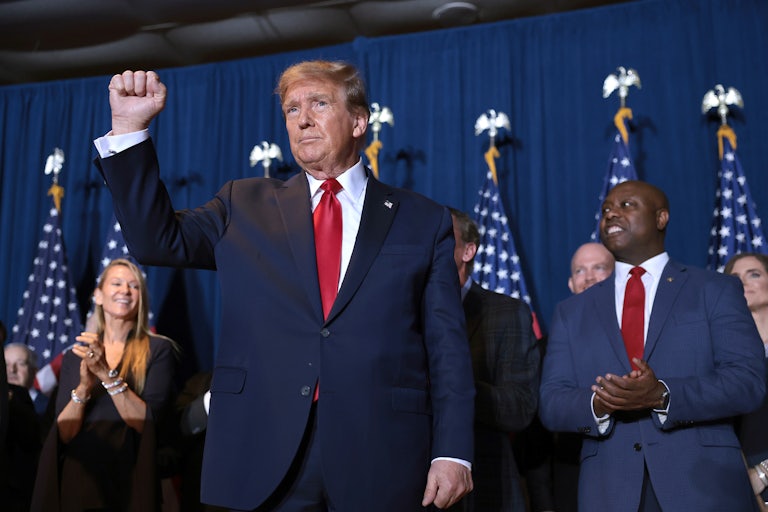
Donald Trump stands while holding his fist in the air
Win McNamee/Getty Images

The Supreme Court has said it will hear the case on whether former President Donald Trump can claim presidential immunity to get out of his federal election interference trial.

But that announcement, which came Wednesday, has legal experts concerned about how this could just be a delay tactic by the Supreme Court and its three Trump-appointed justices.

Until the Supreme Court issues its final decision on Trump’s immunity claim, the federal trial over Trump’s efforts to overthrow the 2020 election—overseen by Judge Tanya Chutkan and originally scheduled to begin next week—will remain on hold.

Legal analyst Lisa Rubin explained on MSNBC Thursday just how much the Supreme Court’s decision shifts back the timeline for when Trump could finally be in a courtroom and potentially face justice over his actions around the 2020 election.

“When Donald Trump’s case was paused to allow for further consideration of the immunity issue, there were 88 days left till trial,” Rubin said. “Judge Chutkan has publicly committed herself to giving Donald Trump around seven months to prepare for trial. So we have to assume that she takes that 88 day remainder fairly seriously. She has also said … that this is a trial that will take around three months. So you have to build into the calendar that 88 days plus 90 days to try the case, if you think that this is going to happen before the election.”

“And that’s why folks like me are asking the Supreme Court, why didn’t you write like you’re running out of time?” she continued. “Because time is quickly elapsing here.”

The Supreme Court has said it will hear arguments beginning the week of April 22.

While many legal experts agree that the Supreme Court will likely strike down Trump’s presidential immunity claim, as Rubin explained, they have different opinions on how quickly they think the Supreme Court will actually issue that decision after hearing the case.

Neal Katyal, the former acting U.S. solicitor general, thinks the decision will come pretty quickly, perhaps by early May. But if we consider Rubin’s math, even in the most sped-up version of the timeline, Trump wouldn’t face a decision in the federal election interference trial until early November. The 2024 election is on November 5.

The Supreme Court’s term usually ends at the end of June or early July. If the court waits until then to issue its ruling, the timeline looks even worse.

Former appeals court Judge Michael Luttig predicted that it is “unimaginable” that Trump will be tried in special counsel Jack Smith’s federal election interference trial before the 2024 election.

Harvard Law professor Laurence Tribe also warned that the delay we’ve seen thus far “is just the beginning.”

“If [the Supreme Court] really had any interest in expedition, any interest in satisfying the public need to get this trial going and to have a verdict one way or the other before the election, they would have asked a narrower question,” Tribe told MSNBC Wednesday night. “They would have simply asked whether a president charged with criminally seeking to remain in office beyond the end of his term has absolute immunity from prosecution or crimes committed in that vein. That would have been the right question to ask, and it could have only had one answer.”

Of course, the Supreme Court’s scope in hearing the case is much broader—and it won’t even begin considering the many questions of immunity until April.

As a reminder, Trump’s immunity claim is so outlandish that it has been struck down by two courts already. At one point, his lawyers even tried to argue that a president would be immune from criminal prosecution if he ordered the assassination of a political rival, so long as Congress did not vote to impeach him first.